How to Find Nether Portal Again
The creation of nether portals can be used for a diversity of unlike means. This page lists some of the implications of these portal mechanics.
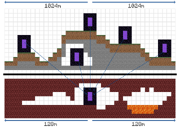
Overworld portals can become a long manner, i way.
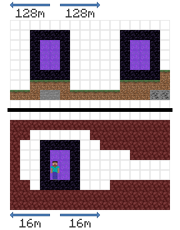
Nether portals go a relatively short altitude; but the left Overworld portal is in range.
Contents
- 1 First, portals are risky
- one.i Portals can accrue Overworld mobs
- ii Making a portal
- ii.i Farming obsidian
- 2.2 Creating a portal without getting obsidian
- 2.2.1 A quick, simple method using a lava puddle, water bucket, and some blocks
- three How portals work
- 3.1 Pairing portals
- 3.ii Zones of exclusion
- 3.iii 2-in-1 Under portals
- 3.four Spawning a portal in the air or buried.
- 4 Using portals
- iv.ane Portals can exist born networks
- 4.two ane-way long altitude teleport
- 4.3 Not-exploit water ladder replacement
- five Videos
- 6 References
First, portals are risky [ ]
Portals try to avoid spawning over lava, in midair, or inside rock, but they exercise and then past spawning nearby. Thus, a new portal from the Overworld has a asymmetric take a chance of being adjacent to an abyss, lava lake, or netherrack wall. There is also no cheque as to whether a lava source (created with the landscape) is destined to send lava flowing over the portal. Furthermore, a portal can spawn on a one block thick ledge or floor, or on a Soul Sand outcrop.
Portals can accumulate Overworld mobs [ ]
Portals built in the Overworld should be secured in order to foreclose wandering monsters from entering the portal. These creatures can accrue over fourth dimension in the Nether; not only is at that place no sunlight to burn undead, but without a player present, time will barely pass for them (15 seconds for each new entry) then they may not have time to despawn. Mobs such as creepers are especially bad to handle in the Under due to the soft nature of netherrack and the affluence of lava to fall into.
Making a portal [ ]
Farming obsidian [ ]
Run into Tutorials/Obsidian farming.
Creating a portal without getting obsidian [ ]
Nether portals can be built without the apply of a diamond or netherite pickaxe to mine obsidian by placing lava in a mold of other blocks and then pouring water over it to turn information technology into obsidian.
| Dirty Under Portal Guide (view on YouTube) |
|---|
A quick, simple method using a lava puddle, h2o bucket, and some blocks [ ]

Lava pool, simple portal making. Click paradigm to play gif.
You volition only need at to the lowest degree 6 blocks, a water bucket, a lava pool, and a flint and steel(or other lighting method). A block breaking tool is recommended.
- As shown in the adjacent gif, start past placing a cake at the border of a lava puddle.
- Place h2o to the left of the block.
- Destroy the block.
- Choice up the water.
If the bottom two blocks are fabricated of obsidian (as shown in gif):
Good, everything is going fine, as you will need all 4 of the obsidian and so far. Continue to step v.
If the bottom two blocks are Non made of obsidian:
Because yous are missing those bottom blocks, which are supposed to exist obsidian, you need to destroy those blocks. Later on destroying those blocks, fill them with lava and use flowing water to solidify them with obsidian. Once y'all have all iv obsidian blocks at that place, you can proceed to footstep 5.
5. Identify those ii blocks, as shown in gif.
6. Place those four blocks, as shown in gif.
seven. Identify water as shown in gif.
8. Catch the water and calorie-free the nether portal with a flint and steel. To get that, you volition need gravel and atomic number 26
How portals work [ ]

This folio describes content that exists only in outdated versions of Minecraft.
The portal search range has been changed.
Portals try to link up at their equivalent location calculated by Overworld (X,Y,Z) <=> Nether (X/8, Y, Z/8). But as they say, the devil is in the details:
- First the game calculates the "ideal" destination coordinate as above, dividing or multiplying the traveler'south X and Z coordinates past 8. Information technology then searches for existing portals (actual portal blocks) inside nearby chunks.
- If going to the Nether it searches a 3x3 chunk area (that is, the clamper of the "ideal" coordinates, and the next chunks).
- If going to the Overworld, it searches a much larger area, 17x17 chunks (that is, upwardly to eight chunks away from the original point).
- In either dimension, the entire vertical range of the world is scanned.
- For any column of portal blocks (such every bit the ii iii-high columns of a "standard" portal), but the lesser one is considered.
- If any portals are found in this range, the traveler is teleported to the closest of them, based on the Euclidean (not taxicab) distance in all three coordinates. Differences in the Y coordinate can bypass the portal that's closest in only X and Z!
- If no portals are constitute within range, the game sets out to make a portal:
- It searches inside 16 blocks horizontally (but any distance vertically) of the histrion's destination coordinates.
- For the first pass, a valid location is 3×4 buildable blocks with air 4 high above all 12 blocks. When plenty space is available, the orientation of the portal is random. The closest valid position in the 3D distance is e'er picked.
- If no such space is found, it tries once again looking for a narrower fit: A 1x4 area of buildable blocks, all the same with air four loftier above them.
- If both of the above fail, the game forces a portal:
- The ideal X and Z coordinates are used, but Y is clipped to exist between 70, and ten below the world top (i.east. 118 for the Nether or 246 for the Overworld).
- A 2×iii platform of obsidian with air 3 high higher up is created at the target location, overwriting whatever might exist there. This provides air infinite underground, or a small platform if high in the air. In Bedrock Edition, the platform includes four more blocks of netherrack on each side, a total of 12 blocks of platform.
- When creating a portal, the game always makes a 4x5 frame of obsidian, including corner blocks.
Pairing portals [ ]
To gear up pairs of Under portals properly then that they reliably travel to each other, it is best to build both portals manually. Build at desired location X,Y,Z in the Overworld. Then travel to the Nether. And and so dig your way to X/8, Y, Z/8, and build a portal at that place.
A less precise method would be to temporarily conciliate all portals within a 128 block "radius" from within the Nether. Through death or with the aid of a second player, entering a new portal from the Overworld volition force the creation of a new portal within the Nether which the Overworld portal should prefer. This is not recommended as it limits how close Overworld portals can exist placed due to the zone of exclusions and can lead to unpredictable placement of the resulting portal.
The Y coordinate is non divided for pairings, however information technology does play a factor in mapping the portals. Therefore, two Overworld portals could be built at the same x,z coordinates with i at a very low Y, e.grand., 5, and one at a higher y, east.g. 160. A Nether portal at these 10 and Z coordinates will link to whichever portal is closest on the Y axis.
If this all sounds complicated to you lot, this website can assist you in the process: https://gamertools.net/minecraft/under/.
Zones of exclusion [ ]
The Nether portal spawning algorithm can simply spawn a portal within a 33×33 block column centered on the destination, just it does scan that width (and the pinnacle of the earth) for open up space to place the portal. This will often cause it to spawn a portal at a location significantly different than the corresponding location in the other globe. The larger the distance between a portal and its "ideal" destination, the larger the zone of exclusion. This zone is the area in each world where you lot cannot build another portal without breaking the link between the first two portals. One way to remember of this zone is as spheres effectually each portal, each of a true radius equal to its distance to the equivalent location of the other. For example, if the Overworld portal was at (0,50,0) and the Nether portal at (0,100,0), and so the portals are fifty meters away from each other. In this (simple) case, if a Nether portal was built closer than 50 meters to (0,50,0), and so the Overworld portal will now link to it.
Because of the coordinate change, portals created in the Nether are much more likely to have platonic coordinates that are horizontally afar from the Overworld portal that created them -- indeed, when used, they may create a new portal in the Overworld, rather than linking back to the original portal! When going the other way, horizontal coordinates tend to exist closer to platonic (because whatever space is found will accept a Nether-equivalent location closer to the original portal), but vertical displacement can yet exist an consequence. Overworld portals that are within 1024 blocks distance of each other on both X and Z axis are nearly always going to link to the aforementioned Nether realm portal on initial construction, unless more than precisely paired portals are congenital (see below).
If you wish to ensure that two portals link together, manually build portals equally close as possible in all 3 coordinate axes. Information technology doesn't have to exist exact, or fifty-fifty all that shut, if the player ensures that no other portals volition be synthetic in the exclusion zone created by the departure.
2-in-1 Under portals [ ]
It is possible to end up in a situation where a Nether portal "randomly" places the player in one of 2 possible Overworld destination portals. This is just because the Nether portal has ii effective coordinates as it is 2 blocks wide, say (X, Y, Z) on the left, and (X+one, Y, Z) on the right. If the player entered on the left side, (Ten, Y, Z) translates to (X*8, Y, Z*8) in the overworld and the game picks the portal closest to that. If the thespian entered on the right side, (X+ane, Y, Z) translates to (10*eight+eight, Y, Z*8) and the game picks a portal closest to that indicate instead. This situation occurs when the Nether portal'southward location is roughly equidistant between the 2 Overworld portals (within 8 blocks overworld distance difference). However, building 2 Nether portals side by side is probably better for destination clarity than building a 2-in-1 portal. It is possible to span distances with pairs of portals in this manner, though normally faster to simply walk through the Nether.[1]
Spawning a portal in the air or buried. [ ]
It is possible for a destination portal (either in the Nether or in the Overworld) to spawn floating in the air, or buried in netherrack or rock. If your portal spawns in the air, it will generate a one×two×1 obsidian platform in the front and dorsum of the portal. If it spawns in rock, a 3-loftier airspace will exist cleared out for one block on each side of the portal. This can merely occur if there there are no existing portals within range to link to, and there is no suitable spot to place a new portal within 16 blocks horizontally (at whatever height) of the target coordinates. This unremarkably means that floating portals spawn over the sea (in the Overworld) or lava sea (in the Nether), and cached portals are much more likely in the Nether.
Using portals [ ]
Portals tin can be born networks [ ]
Y'all should build portals at 64 Nether block intervals, even if you are not normally going to use these gates. (This is the maximum ideal distance, but they tin can be built as close to 16 Overworld blocks apart, if the coordinates are accurate.) This is then that if you lot apply Nether portals for long-distance travel, and your usual Overworld destination portal becomes inaccessible for some reason, (due to large gravel cave-ins, lava, water, or yous have an automated activation organization and forgot to turn information technology on) you lot volition however have a reasonably shut backup gate, which will go you lot back into your gate network.
ane-way long altitude teleport [ ]
The portal choosing algorithm can be used for long-distance travel by manual construction at carefully selected coordinates. If the actor has a portal in the Overworld at (0,64,0) but makes a Nether portal at (127,64,127) with its perfect Overworld pair at (1016, 64, 1016), and so the portal at (0,64,0) will get to the Nether portal correctly (ane-fashion trip) because it is the only portal available within the 128 search distance along X and Z horizontal axes of the expected Nether portal position of (0,64,0). In about 15 seconds, the player tin and then travel 1436 meters in the Overworld. This specific form of fast travel by portal is i-fashion, since the Nether portal volition not observe this Overworld portal. Given that a railway in the nether would need to span just 180 meters to go this distance, it is usually not worth making such portal links. Notwithstanding, it is theoretically possible to make a ane-style ring of portals, with each Overworld to Under bound going a long distance, merely such a band would hands be disrupted due to the huge exclusion zones created.[two]
Non-exploit h2o ladder replacement [ ]
The Nether portal is an likewise entirely viable, two-way replacement for the water or conventional ladder.[iii] Annotation that if you want to travel a vertical altitude of h from a point (X, Y, Z) in the Overworld to (X/8, Y+h, Z/8) in the Nether, there must be no other Overworld portal at any betoken (x, y, z) within a altitude of eight*h from (X, Y, Z) (i.due east. within the spheroid ((x-Ten)/8)² + ((y-Y)/i)² + ((z-Z)/8)² = h², note that Y is not divided by 8). That is, if y'all want to travel large vertical distances, there must be no horizontally close portal. (This holds for a portal from the Overworld to the Nether. The reverse management (Nether to Overworld) was not discussed hither.)
Videos [ ]
References [ ]
- ↑ https://youtube.com/watch?v=acbAi2ZR_Ww
- ↑ http://www.minecraftforum.net/topic/345806-nether-portal-science/page__st__40__p__5093671#entry5093671
- ↑ https://youtu.be/zbsFGXPTHDU
severinocorry1942.blogspot.com
Source: https://minecraft.fandom.com/wiki/Tutorials/Nether_portals
0 Response to "How to Find Nether Portal Again"
Post a Comment